PulseGTO
Benchmarks & research
PulseGTO vs GTO Wizard and HRC: preflop benchmarks
Public numerical comparisons of preflop action frequencies and expected value are below. These are PulseGTO tests, not independent third-party reviews. For postflop accuracy, time and memory measurements see PulseGTO vs PioSOLVER.
PulseGTO preflop results were compared against GTO Wizard and HoldemResources Calculator (HRC) to check strategy agreement and expected-value differences. Each table uses the same game on both sides: players, stacks, blinds, rake and preflop sizes. Reference numbers are read from the reference's own display.
These comparisons are correctness checks, not general solver rankings. Differences can come from the game trees, rake rules, postflop modelling and convergence settings.
All comparisons are independent. PulseGTO is not affiliated with, sponsored by, or endorsed by GTO Wizard or HoldemResources.
GTO Wizard: 6-max cash, 20 bb, 5% rake
Configuration: six players with 20 bb, blinds 0.5/1, rake 5% capped at 3 bb, no flop no drop. Opens 2.5 bb (small blind 3 bb), cold calls allowed, all-in available at every level. Reference: GTO Wizard's precomputed solution of this game. PulseGTO: default settings, 40,000 samples. Metric: share of hands, %.
| First-in raise | UTG | HJ | CO | BTN |
|---|---|---|---|---|
| reference | 16.8 | 19.7 | 23.6 | 29.9 |
| PulseGTO | 16.5 | 19.2 | 23.2 | 29.3 |
| Big blind vs small blind raise to 3 bb | fold | call | raise | all-in |
|---|---|---|---|---|
| reference | 56.7 | 18.0 | 7.7 | 17.5 |
| PulseGTO | 54.7 | 23.7 | 5.2 | 16.3 |
| Big blind vs small blind complete | check | raise | all-in |
|---|---|---|---|
| reference | 60.7 | 23.4 | 15.9 |
| PulseGTO | 64.4 | 21.7 | 13.9 |
The small blind's value of the spot when everyone folds to it is 0.276 bb in the reference and 0.279 bb in PulseGTO, averaged over all 169 hands. The two solutions split the small blind's playable hands differently between completing and raising; for the hands involved, the two actions are worth the same to within about 0.02 bb.
GTO Wizard: heads-up, 20 bb, with and without rake
Configuration: heads-up, 20 bb, the small blind opens 2.5 bb or completes, the big blind raises a completed pot to 3.5 or 7 bb. Reference: GTO Wizard's precomputed solutions of this game with 5% rake capped at 3 bb and without rake. PulseGTO: 5,000 samples. Metric: the small blind's value of the game per hand (bb), averaged over hands, and the mean difference per hand.
| reference | PulseGTO | mean difference per hand | |
|---|---|---|---|
| no rake (166 hands shown) | 0.519 | 0.517 | 0.021 |
| 5% rake, default rake rule | 0.379 | 0.398 | 0.045 |
| 5% rake, Rake uncalled bets on | 0.379 | 0.374 | 0.019 |
HRC: heads-up, 20 bb
Configuration: heads-up, 20 bb, open 2.5 bb, big blind raise over a complete 3.5 bb, small blind re-raise 8 bb, 3-bet 5 bb, 4-bet all-in; postflop one bet of 66% of the pot and all-in on every street. Reference: HRC, which plays the postflop by Monte Carlo sampling over fixed hand groups; the tree was built field by field in both. Rake 5% capped at 3 bb with Rake uncalled bets on, which is the reference's rake rule, and without rake. Metric: the small blind's first action, % of hands, and its value of the game per hand (bb).
| fold | complete | raise | all-in | SB value | |
|---|---|---|---|---|---|
| no rake, reference | 3.8–4.2 | 77.8 | 17.5 | 0.9 | +0.038 |
| no rake, PulseGTO | 3.9 | 80.6 | 14.9 | 0.6 | +0.042 |
| 5% rake, reference | 17.9 | 53.2 | 22.8 | 6.1 | −0.131 |
| 5% rake, PulseGTO | 17.4 | 56.3 | 19.9 | 6.4 | −0.131 |
Without rake, the EVs of individual hands agree to the hundredth (for example AA +5.33 and +5.34 bb). With rake, all twelve preflop decision points agree within a few points, and the rake collected is 0.280 and 0.284 bb per hand.
HRC: 6-max, 20 bb, 5% rake
Configuration: six players with 20 bb, blinds 0.5/1, rake 5% capped at 3 bb, no flop no drop, Rake uncalled bets on (the reference's rake rule). Opens 2.5 bb (small blind 3 bb or complete), big blind raise over a complete 3 bb and the small blind's re-raise all-in, 3-bet 5 bb (big blind 5.5 bb), squeeze 6.5 bb (blinds 7 bb), 4-bet all-in, one cold caller, anyone may call an all-in; postflop one bet of 66% of the pot and all-in on every street. Reference: HRC, the tree built field by field in both. PulseGTO: Strength small, 60,000 samples. Metric: share of hands, %, and the actor's value of the decision against folding (bb), from the reference's own node export.
| First-in raise | UTG | HJ | CO | BTN |
|---|---|---|---|---|
| reference | 16.6 | 19.2 | 23.5 | 29.8 |
| PulseGTO | 16.5 | 19.1 | 22.9 | 29.7 |
| value vs fold, reference | 0.093 | 0.108 | 0.131 | 0.170 |
| value vs fold, PulseGTO | 0.092 | 0.107 | 0.130 | 0.169 |
| Small blind first in | fold | complete | raise | all-in | value vs fold |
|---|---|---|---|---|---|
| reference | 46.8 | 10.0 | 35.0 | 8.2 | 0.277 |
| PulseGTO | 47.3 | 7.9 | 35.8 | 9.0 | 0.275 |
| Big blind vs small blind raise to 3 bb | fold | call | 3-bet | all-in | value vs fold |
|---|---|---|---|---|---|
| reference | 57.7 | 16.8 | 3.9 | 21.6 | 0.459 |
| PulseGTO | 56.6 | 18.1 | 4.3 | 21.0 | 0.464 |
Hand by hand, the EV of each open differs from the reference's by 0.007–0.009 bb on average over the opening seat's range. The small blind's complete and raise are worth the same to within about 0.02 bb for the hands it mixes, so the split between them moves more than the value of the spot does.
Scope: one run per row; reference values read from its display to two decimals. Where two actions are worth almost the same, solvers of equal quality can choose different mixes, so compare values first and frequencies second.
A full-size run: 6-max cash, 100 bb, 5% rake
Configuration: six players with 100 bb, blinds 0.5/1, rake 5% capped at 3 bb, no flop no drop. Opens 2.5 bb (small blind 3 bb or complete; the big blind raises a complete to 3.5 bb), 3-bets 7.5 bb in position, 11 bb from the small blind and 12 bb from the big blind (9 bb against a small-blind open), squeeze 10 bb (blinds 13 bb), 4-bets about 2.2× in position and 2.5× out of position, 5-bet all-in, one cold caller. Postflop: flop bets 33% and 75% of the pot, turn and river 50% and 100% plus all-in on the river, one raise of 3× and then all-in (4-bet pots: 33%, 50% or all-in); no donk or probe bets, so the caller of a preflop raise never bets first after the flop. Strength small, 12 threads on a laptop (i5-1235U, 64 GB RAM). There is no reference solution for this tree: the run shows what a full-size game costs and how much it still moves after 100,000 samples.
| 100,000 samples | 200,000 samples | |
|---|---|---|
| Training time (wall clock) | 7 h 05 min | 12 h 29 min |
| Peak working set | 18.3 GB | 20.9 GB |
| Information sets | 164 million | 190 million |
| Blueprint file | 6.2 GB | 7.1 GB |
| Preflop accuracy bound, bb per hand dealt (how to read it) | 0.049 | 0.027 |
| Samples | 5k | 10k | 20k | 40k | 60k | 80k | 100k | 120k | 140k | 160k | 180k | 200k |
|---|---|---|---|---|---|---|---|---|---|---|---|---|
| Preflop accuracy bound, bb per hand | 0.620 | 0.350 | 0.195 | 0.107 | 0.076 | 0.059 | 0.049 | 0.042 | 0.037 | 0.033 | 0.030 | 0.027 |
| First in, share of hands (%) | UTG raise | HJ raise | CO raise | BTN raise | SB complete / raise | BB vs complete: raise |
|---|---|---|---|---|---|---|
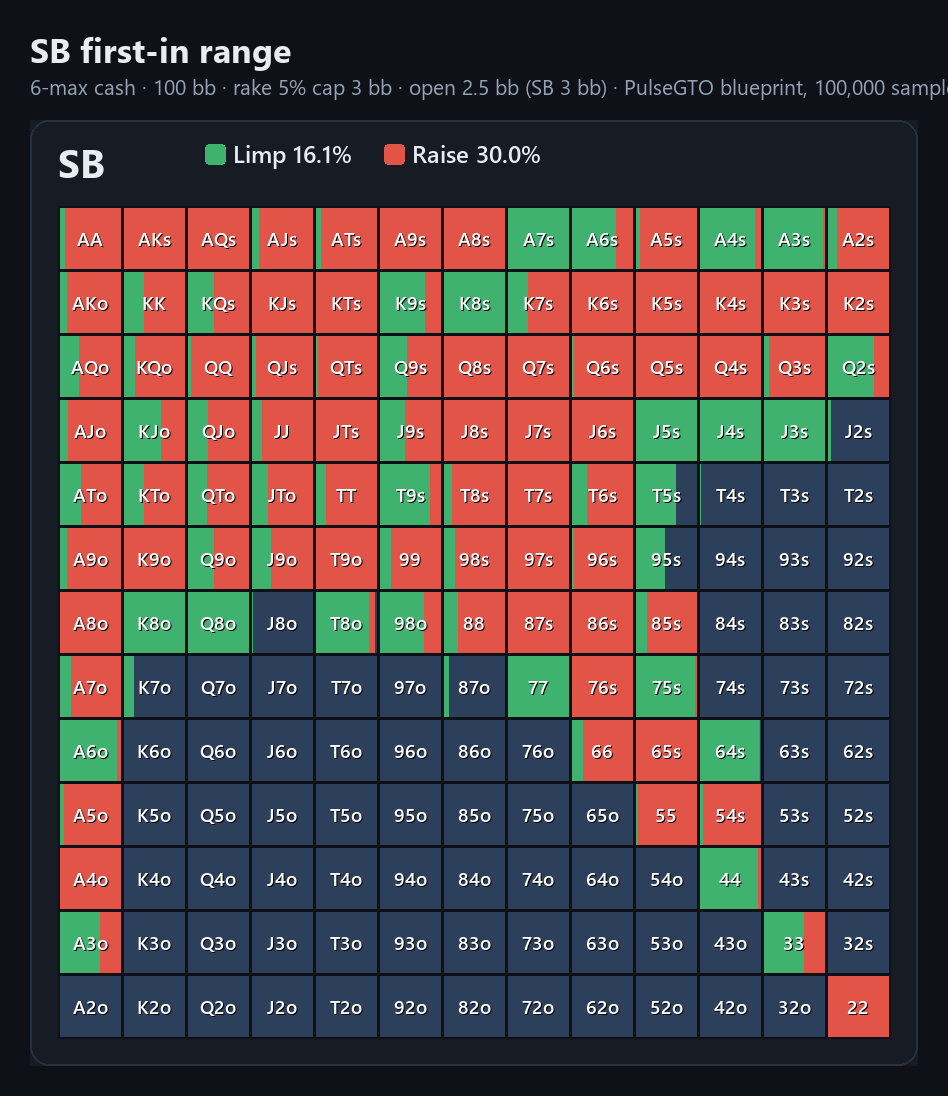
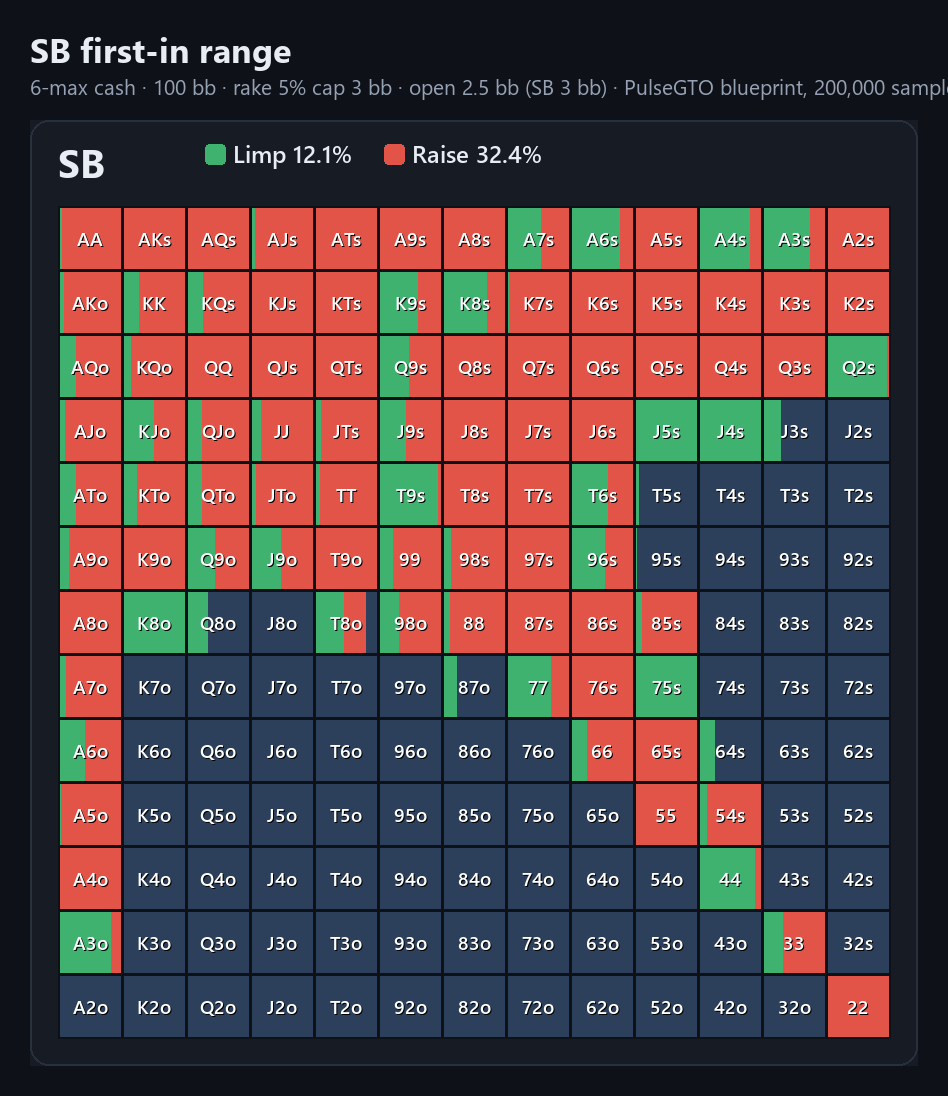
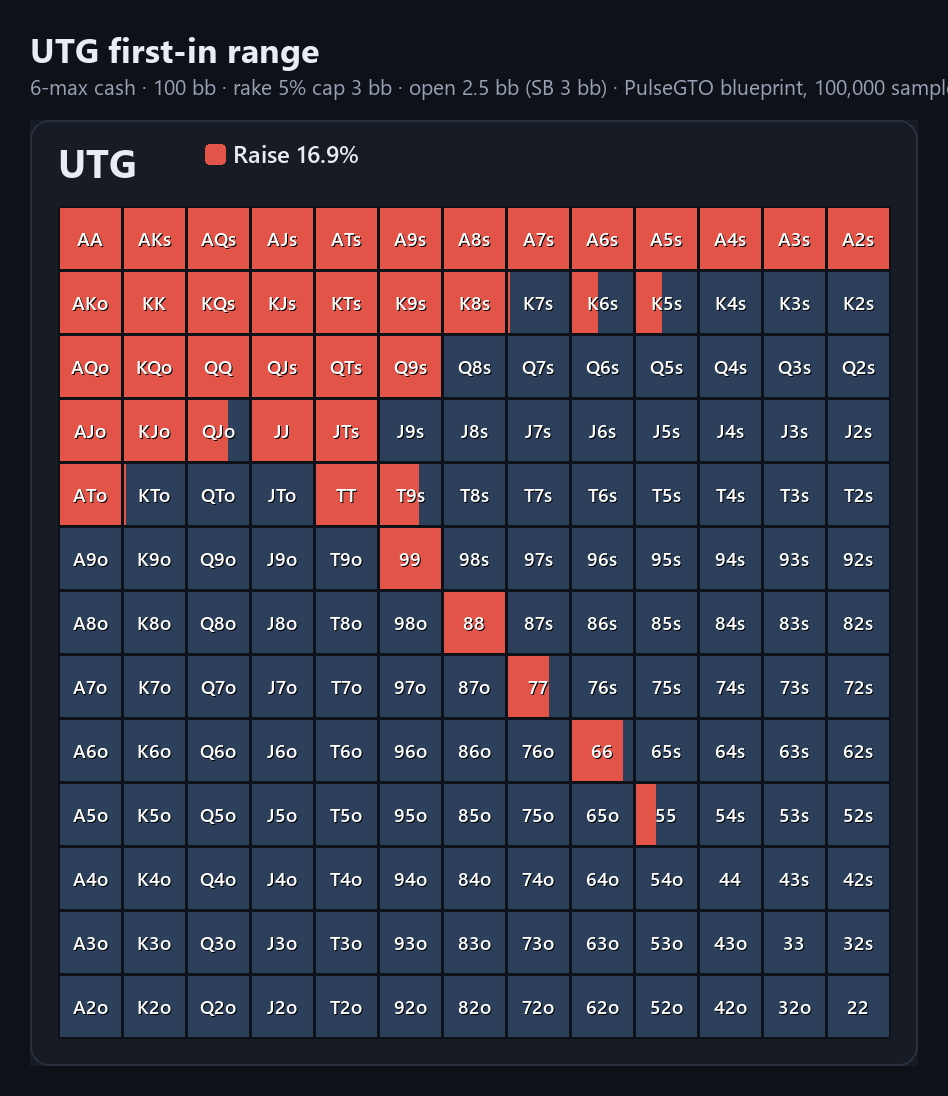
| 100,000 samples | 16.9 | 21.3 | 29.3 | 46.5 | 16.1 / 30.0 | 39.0 |
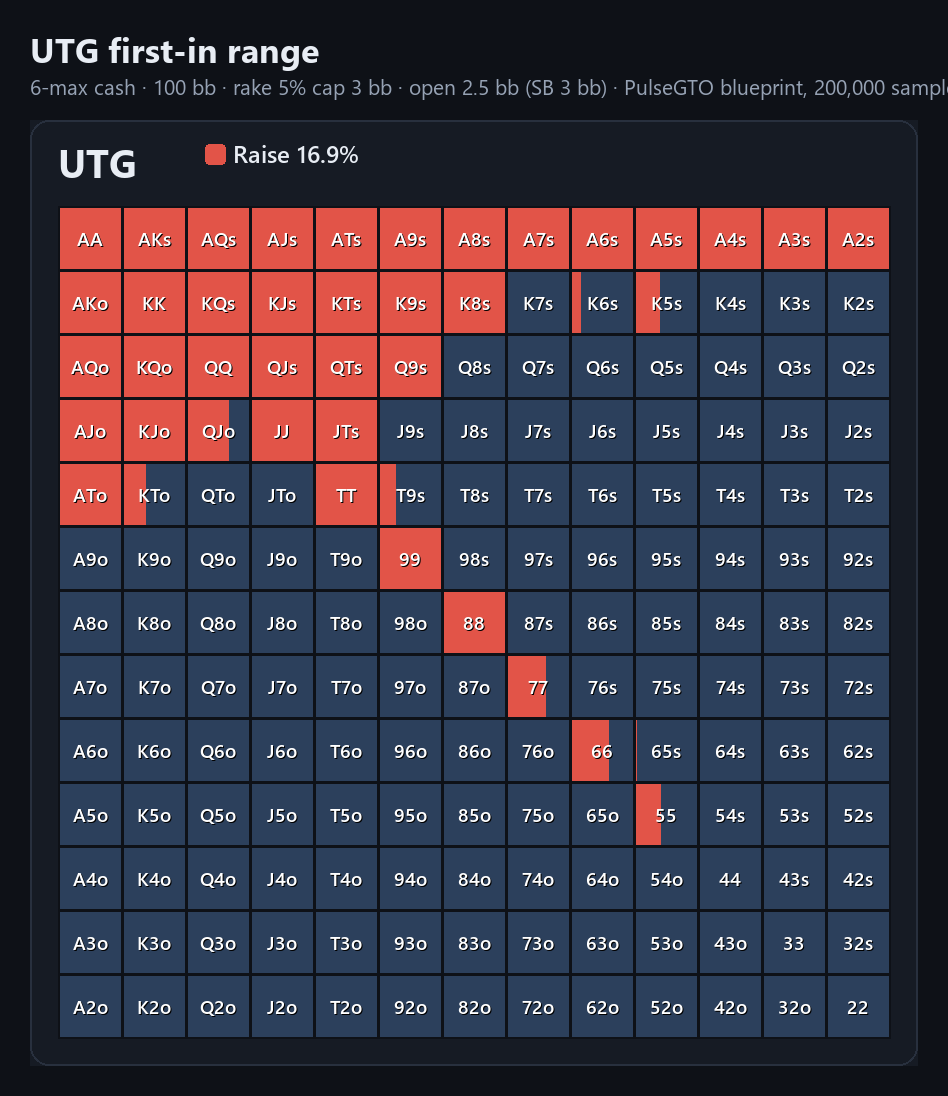
| 200,000 samples | 16.9 | 21.5 | 29.5 | 46.5 | 12.1 / 32.4 | 39.9 |
| EV loss of the 100,000-sample mix, bb per hand dealt | 0.0000 | 0.0001 | 0.0001 | 0.0000 | 0.0006 | 0.0017 |
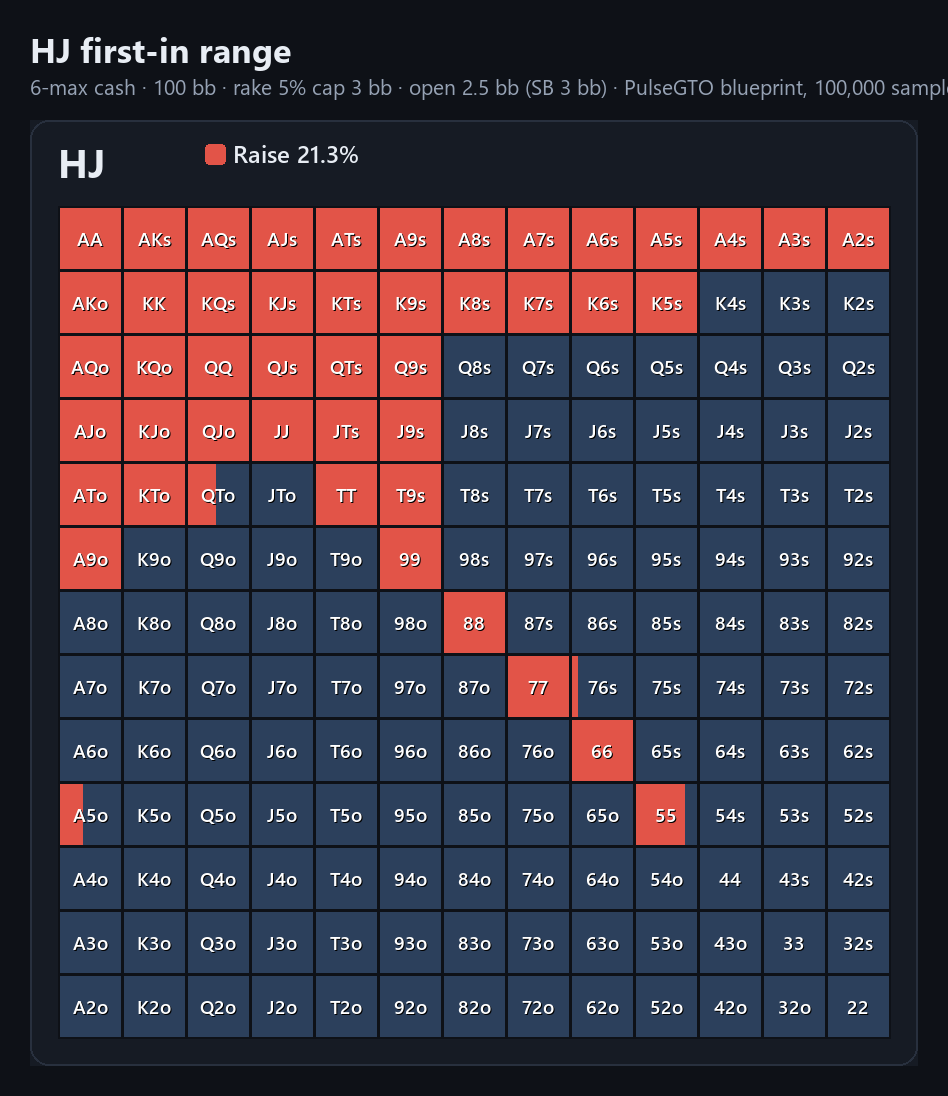
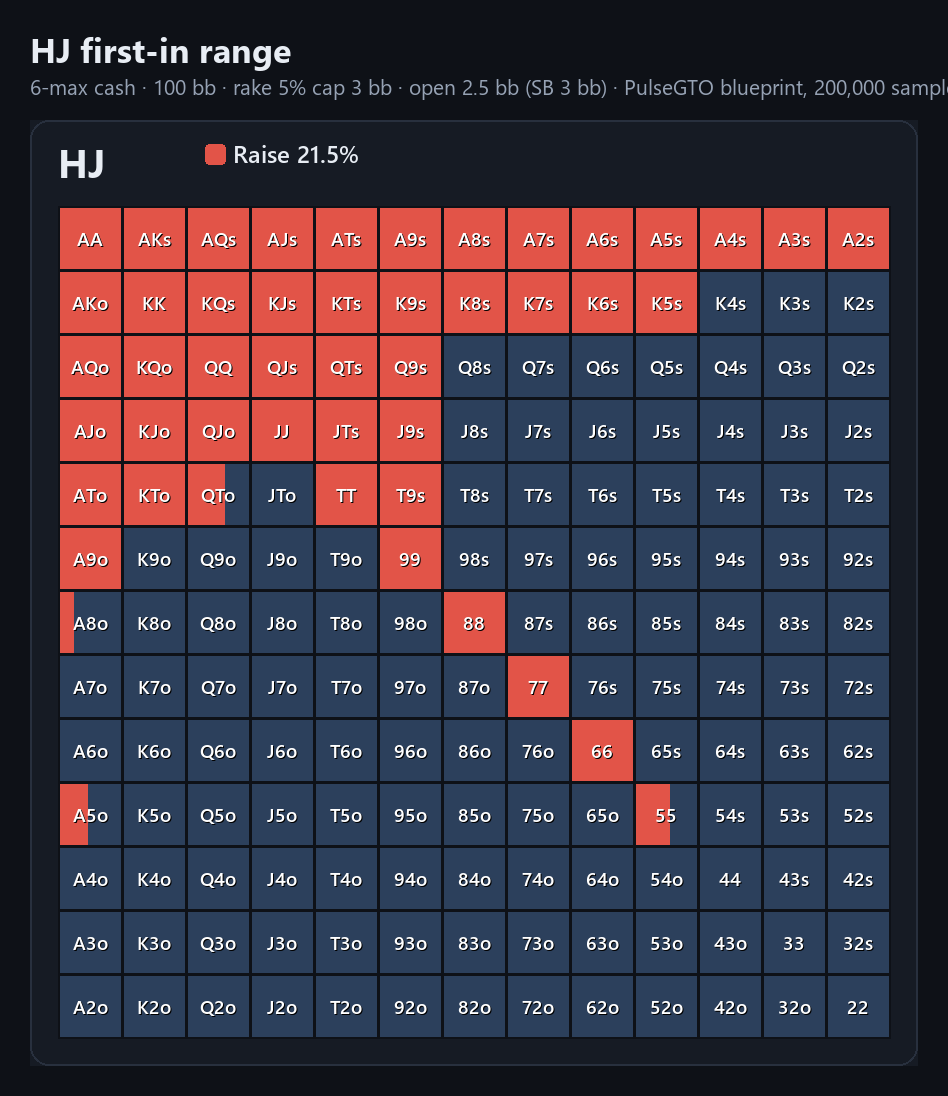
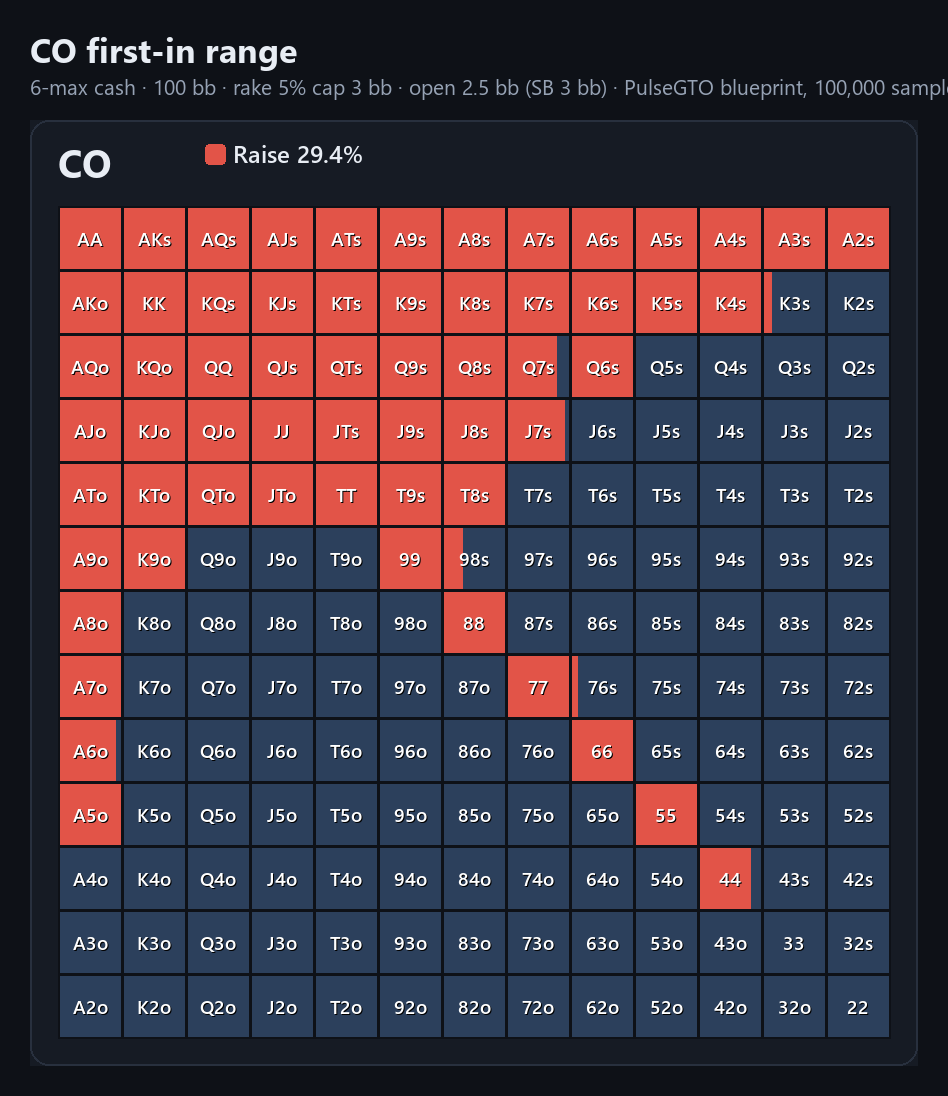
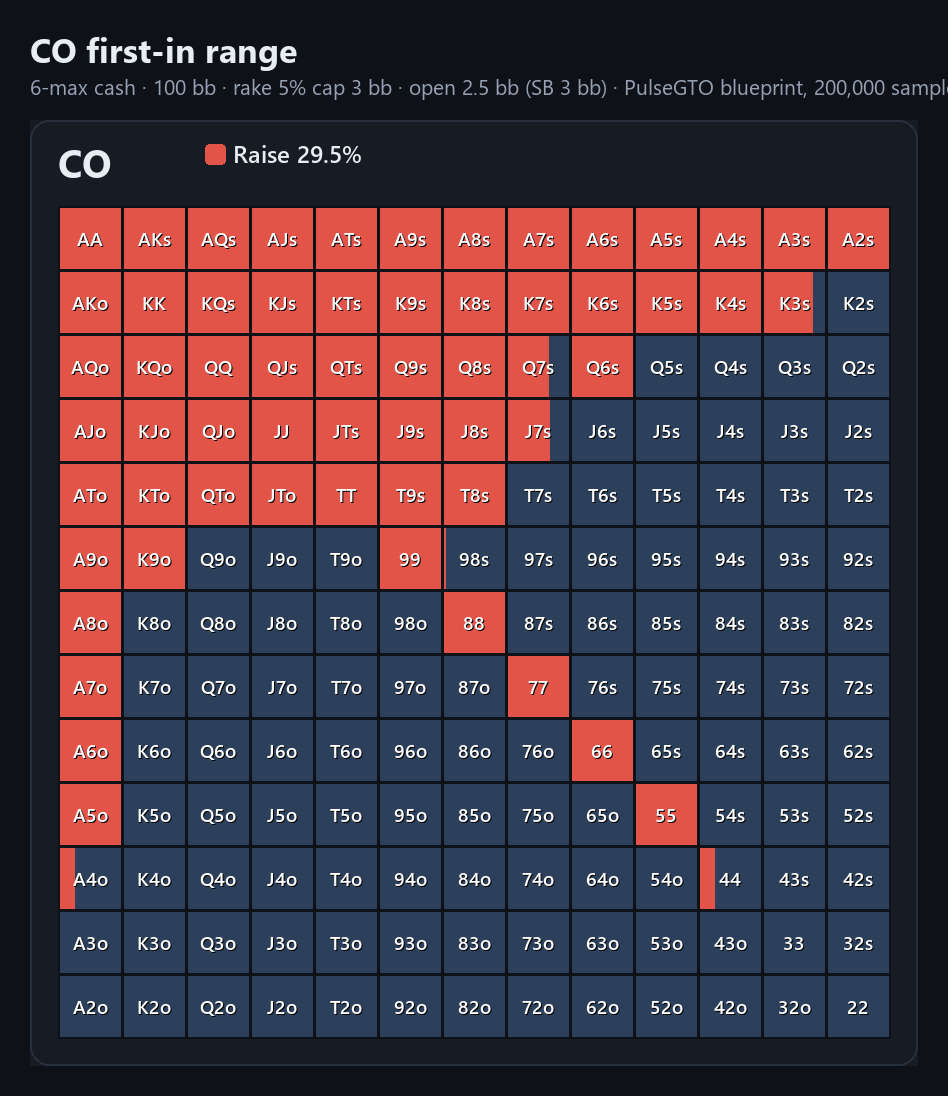
The EV loss is what the 100,000-sample strategy gives up per hand dealt against the best action, valued with the 200,000-sample EVs (folding is 0; see EV loss as a quality measure). From UTG to the button the first-in ranges were finished at 100,000 samples: at most 0.0001 bb per hand. The hands whose frequency still moved by 15 points or more (at UTG: KTo, K6s, T9s and 66) have their two best actions within 0.005 bb of each other, so they are mixes rather than mistakes. The small blind's complete and the big blind's answer to it still move (the complete went from 16.1% to 12.1% of hands); they are the flattest spots of the game, with up to 0.01 bb (small blind) and 0.03 bb (big blind) between the two best actions of the hands that moved.
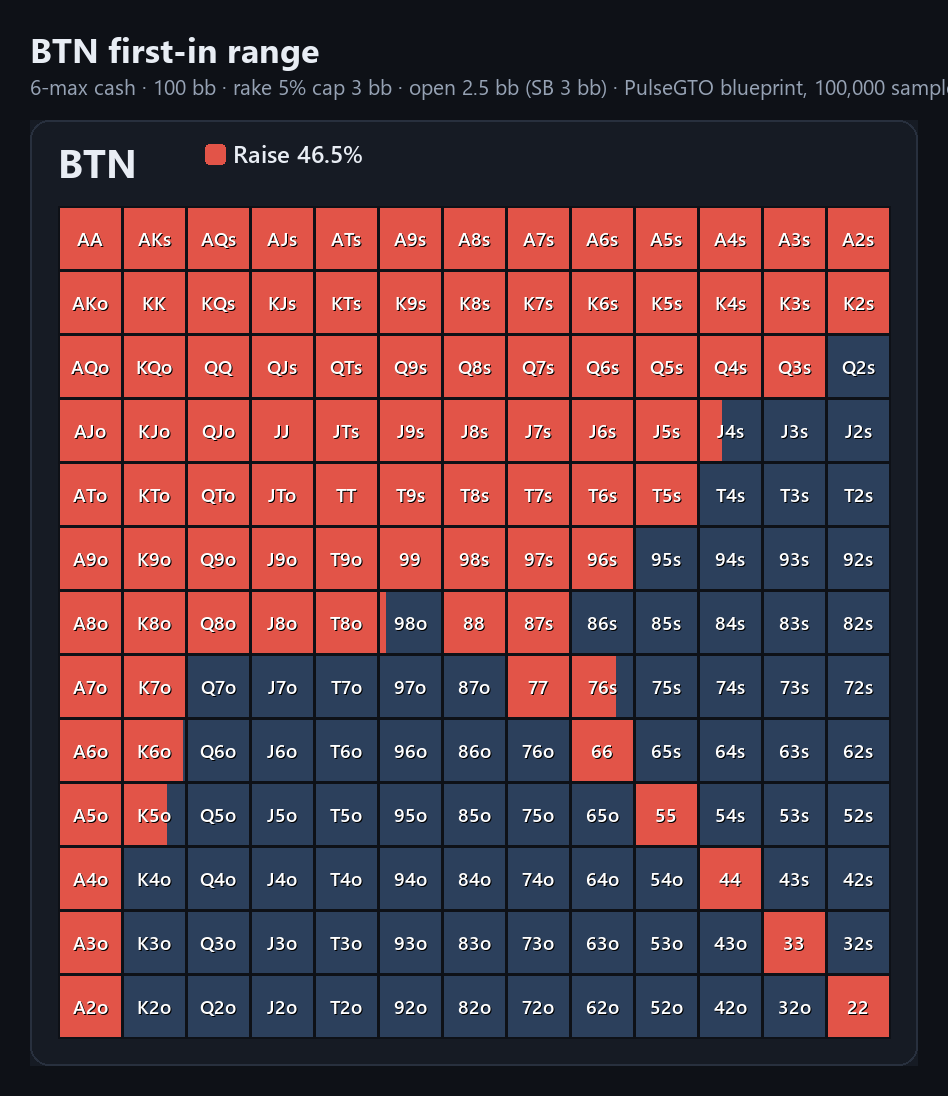
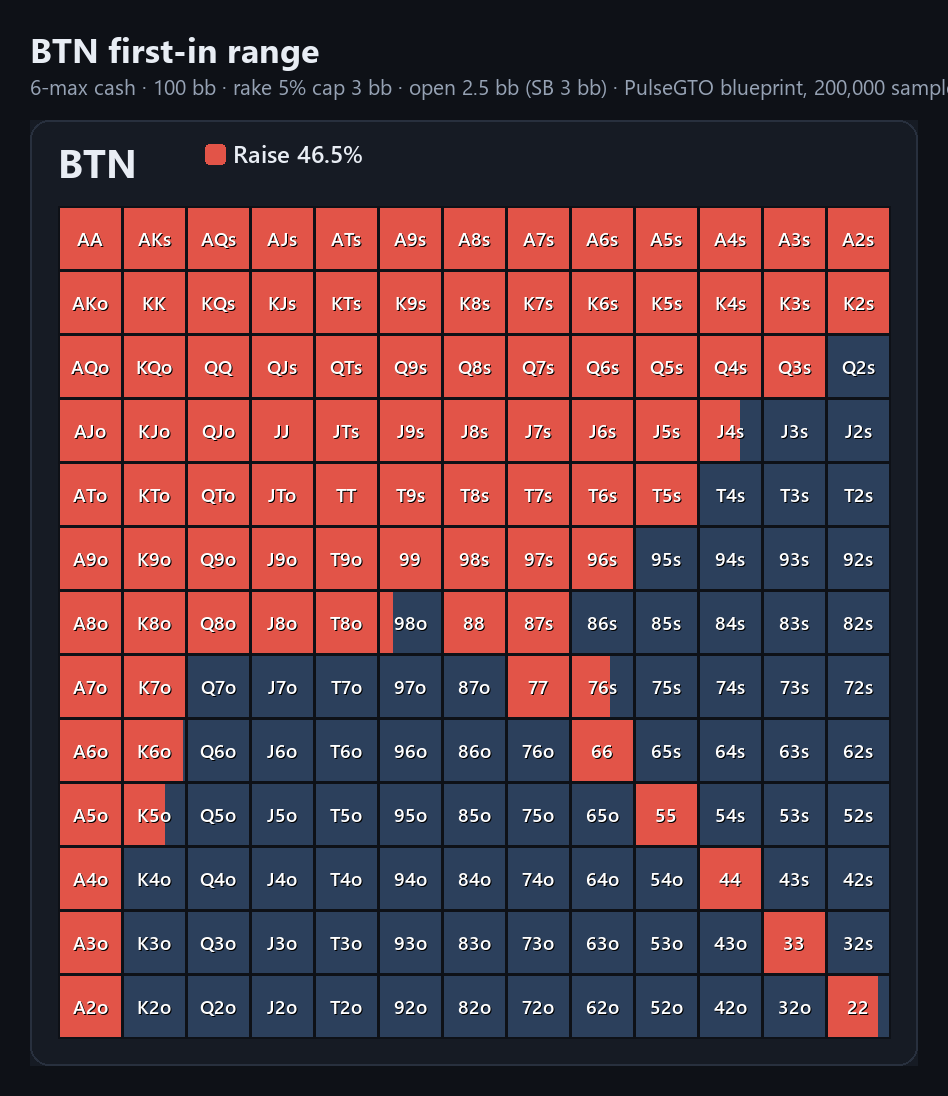
First-in range grids: 100k vs 200k
Averaged strategies from the same run, by position. These grids illustrate convergence within this tree, which has no donk or probe bets; they are not reference ranges for unrestricted 6-max play. Click a grid to view it at full size.
UTG first-in
HJ first-in
CO first-in
BTN first-in
SB first-in