 PulseGTO
Multiway · No-Limit Hold’em
Three-way postflop solving, with three separate ranges
A third player changes card removal, action order and who can win each side pot. Use a three-player solve for that spot instead of treating it as a heads-up pot with extra dead money.
What “multiway” means here
PulseGTO trains preflop blueprints for two to six players. Its dedicated postflop solver supports two or three players. A three-way solve tracks the combinations in all three ranges and solves the configured betting tree. Four or more players on a postflop node still use the blueprint strategy; they are not covered by the dedicated RangeCFR re-solve.
This distinction matters when comparing tools advertised as “multiway”: a six-player preflop game and a three-player postflop solver are different capabilities. The game is NLHE with chip-EV payoffs and configurable rake, not an ICM calculation.
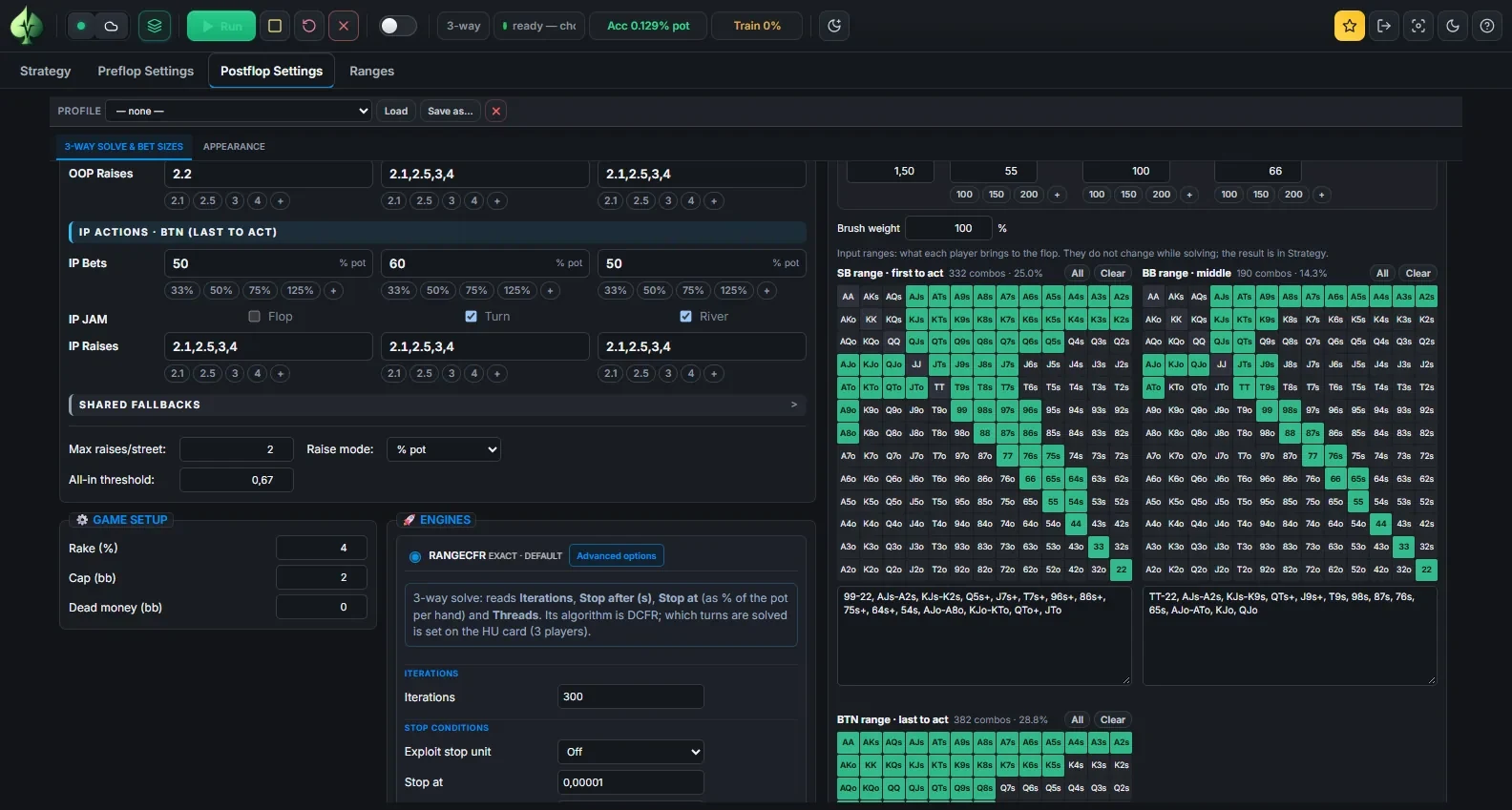
Build a three-player spot
- In Postflop Settings choose the three-player card, labelled SB, BB and BTN in action order.
- Enter the board, pot and each stack behind. These are the state at the starting street, not the original preflop stacks.
- Provide three weighted ranges. Remove impossible board combinations and preserve the range weights you intend to model.
- Configure the bet tree, rake and stopping conditions. Check the RAM estimate.
- Start the solve, inspect each player’s strategy and read the accuracy together with the card coverage.
You can also start from a three-way node of a loaded blueprint. Its re-solve uses the ranges reaching that line. If you edit those ranges, you are studying a different game.
Flop, turn and river coverage
| Start | Future cards | What to check |
|---|---|---|
| River | No further cards | Ranges, side pots, bet sizes and convergence |
| Turn | Every possible river | RAM and the stack-to-pot relationship |
| Flop | All turns and rivers when the tree fits | Whether RAM or quick preview reduced turn coverage |
If memory limits the flop solve, fewer turns may be covered. A low reported accuracy then applies to those solved cards; it does not measure missing turns. For an uncovered turn, start a fresh turn-root solve. Node locks are not supported by the three-way re-solve.
Side pots are part of the game
For a simple illustration, if three players contribute 10, 20 and 20 bb, the contested contributions form a 30 bb main pot and a 20 bb side pot. The short stack can win the main pot but not the side pot. Dead money and actual betting history also matter; enter the actual state rather than substituting a heads-up pot.
The engine handles blockers, folded hands, ties, side pots and rake. This does not remove finite-iteration error or errors in your input ranges. Internal payoff and convergence checks are documented in three-way research.
Read accuracy as a unilateral gain
The three-way metric averages the gain each player could make by deviating alone against the other two strategies. It does not certify resistance to collusion by two players. Do not read it as the same theoretical guarantee as a two-player zero-sum equilibrium bound.
Compare runs only with the same ranges, betting actions, rake, card coverage and metric. A simplified tree may converge faster but answer a narrower question. See the metric definitions.
Try the workflow on your own computer
Start a seven-day Engine trial from your account while the trial campaign is available. Activation and licence validation require internet access. Windows and an AVX2-capable CPU are required. Availability and licence terms are on the pricing page.