 PulseGTO
Learn · Solver methods
What CFR learns, and what a convergence number cannot promise
Regret minimization compares available actions across repeated visits to a decision. It improves a strategy within the game represented by the solver; it does not add missing bet sizes or remove abstraction error.
A small action-value example
Suppose a decision has Check worth 0.20 bb and Bet worth 0.30 bb under the current continuation. A 50/50 mix is worth 0.25 bb. The action differences against that mix are −0.05 and +0.05 bb. A regret-minimization update uses such differences to change future play.
This arithmetic is only an illustration. Counterfactual values and reach weights in a poker game require more care than observing one opponent hand and always picking its best response. A solver must represent decisions without revealing hidden cards to the acting player.
The original CFR paper introduces counterfactual regret minimization. Its theoretical guarantees should not be transferred without qualification to raked, multiplayer or imperfect-recall models.
CFR variants are not different poker rules
| Term | High-level difference | What it does not fix |
|---|---|---|
| CFR | Accumulates counterfactual action regrets | A missing betting action |
| CFR+ | Changes regret handling, including nonnegative cumulative regrets | A wrong input range or rake rule |
| Discounted CFR | Changes how earlier updates influence later learning | The inherent limits of a hand abstraction |
| Monte Carlo CFR | Uses sampled traversals to estimate updates rather than visiting all branches | Sampling error after a finite budget |
These are families of learning methods, not interchangeable accuracy settings. The CFR+ publication and MCCFR publication provide the research definitions. This is educational context, not a claim that every method is a selectable PulseGTO product.
How this relates to PulseGTO
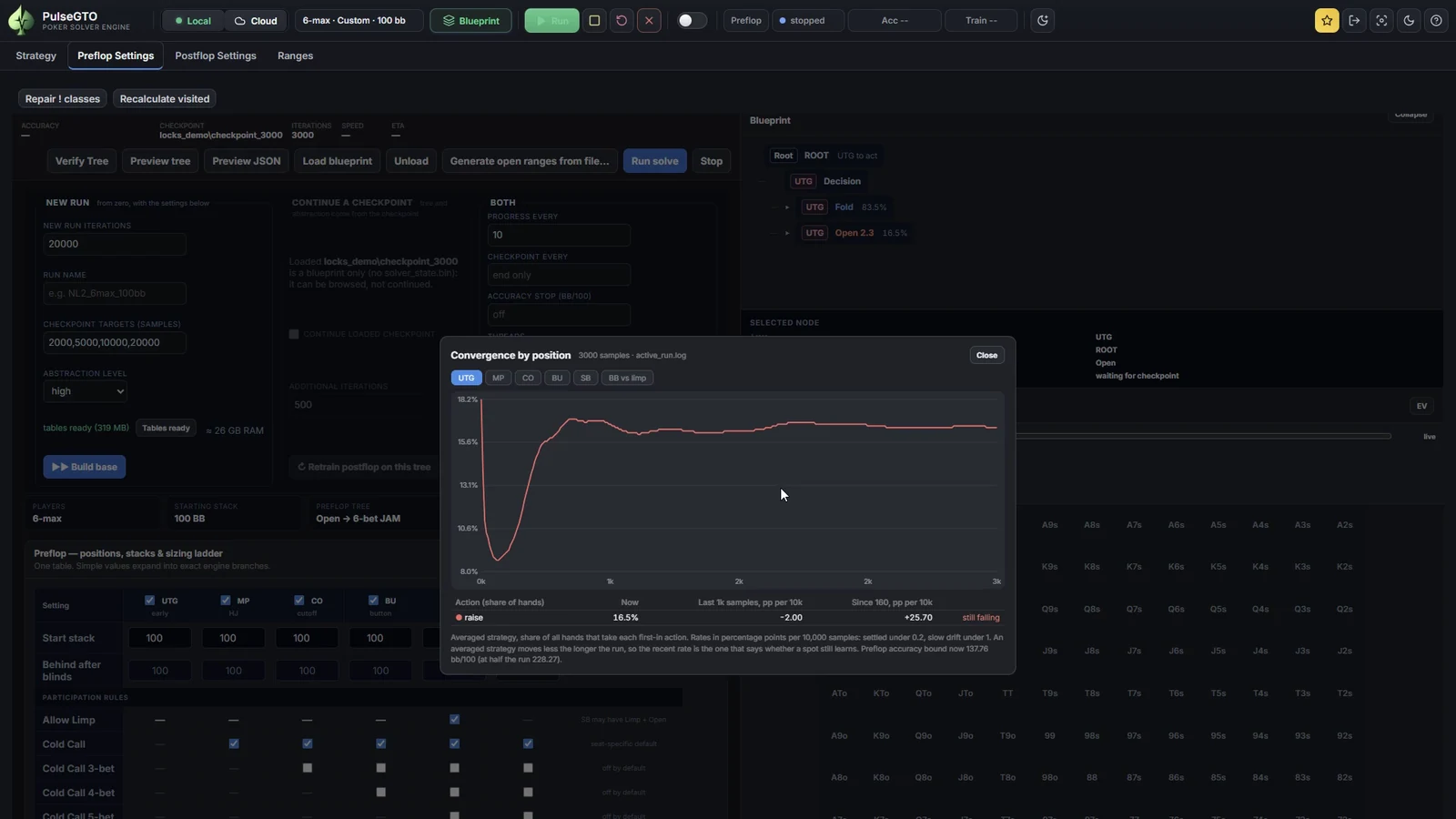
The preflop engine trains a sampled whole-game blueprint with approximate postflop play. New preflop runs use signed regrets; older checkpoints keep their stored regret mode. The strategy you browse is normally the averaged policy rather than only the most recent iteration.
RangeCFR solves selected heads-up or three-way postflop trees per hand combination. It is separate from the blueprint’s postflop abstraction. Do not confuse the sampled blueprint trainer with a standalone MCCFR postflop product: the current public postflop workflows are RangeCFR heads-up and three-way.
Three separate questions about accuracy
- Has the represented game converged? More iterations can reduce residual learning error.
- Does the representation capture the hands and cards you care about? A converged abstraction still has representational limits.
- Does the action tree describe your game? A tree without a bet size cannot discover that size just by training longer.
The blueprint’s preflop regret-based headline is a convergence estimate inside its model. A postflop best-response metric is a different measurement on one subtree. Neither certifies optimality against actions that were omitted. With three players or rake, avoid importing two-player zero-sum Nash guarantees.
Why average strategy and EV need separate labels
A stable averaged mix may look different from the current policy. Historical EV accumulators can also average values encountered under changing policies. They are not automatically an evaluation of the final averaged strategy. Use a converged re-solve when you need per-combination action values in a selected postflop spot.
For practical study, save the ranges, board, tree and stop metric with the result. Judge changes by their EV consequences under a consistent evaluation, not just by whether one hand’s raise frequency moved a few points.
Try the workflow on your own computer
Start a seven-day Engine trial from your account while the trial campaign is available. Activation and licence validation require internet access. Windows and an AVX2-capable CPU are required. Availability and licence terms are on the pricing page.