 PulseGTO
Blueprints & databases
Custom game trees & bet sizes
Preflop (Preflop Settings)
- Seats: UTG, MP, CO, BU, SB and BB, each on or off, with a stack per seat.
- Raise sizes: per seat, for the open, 3-bet, squeeze, 4-bet and 5-bet. An empty squeeze uses the seat's 3-bet size; BB vs SB 3-bet sets the big blind's size against a small-blind open when it differs from its other 3-bets. The 6-bet is all-in. Each level has allow jam and force jam.
- Limps and calls: SB limp (the engine supports limping from the SB only), BB iso-raise with an optional second, larger size, SB re-raise after a limp, cold calls per seat, the maximum number of cold callers, and whether anyone may call an all-in.
- Other settings: all-in conversion %, rake %, rake cap, no flop no drop, and rake minimum pot. By default rake is taken from the matched pot: an unmatched bet is returned before rake, as at real tables. With Rake uncalled bets on, a pot won by a fold is raked in full, the uncalled bet included; use it only to compare with a solver that rakes that way.
- Preflop locks: only the allowed actions for a group of hands at one kind of decision (for example pairs facing an open: Fold or Raise); see below.
Preflop locks
A lock limits what a group of hands may do at one kind of decision; the solver chooses among the allowed actions, and every other seat adjusts to that. The classic use: pairs 22–TT facing an open: Fold or Raise, never Call — the ranges that come out are built for a player who plays pairs that way, and the opens, 3-bets and defences of the other seats are the answer to it.
- A lock names: the seat it applies to (one, or any seat), what the seat faces (first in, an open, a 3-bet, a 4-bet, a 5-bet, a limp), optionally whose raise, whether the seat has already put voluntary money in (an opener facing a 3-bet has; a seat behind the open has not), the hands and the allowed actions. Raise means every sized raise of the tree at that decision; All-in the jam.
- Hands: class names and ranges:
22-TT,22+,A2s-A5s,A2s+,AKo,KQ(suited and offsuit). - Not a fixed frequency: a lock removes actions, it does not set a percentage. With Fold and Raise allowed the solver still decides how often each pair 3-bets.
- Several locks that match the same decision and hand intersect. A lock that would leave a decision with no legal action is ignored there; the training log reports how often that happened.
- What you see: at a locked decision the Strategy grid marks the locked classes with a small lock, and its tooltip names the allowed actions. The locks are part of the tree: a checkpoint trained with them cannot be continued without them (or with different ones), and loading its blueprint restores the lock rows in Preflop Settings.
Postflop part of a blueprint tree
- Presets: Light, Standard, Rich.
- Pot types: shared, limped, single-raised, 3-bet and 4-bet+. Each can have its own sizes.
- OOP and IP bets (up to 4, as % of the pot) and jam.
- Actions at a node: a street with up to three sizes, or two and the jam, has at most four actions at a node (check and three bets) and runs on the standard preflop engine. A street with four sizes, or three and the jam — up to check, four bet sizes and all-in — runs on the wide preflop engine, which the app starts by itself. Every extra size multiplies the tree below it: Check tree shows how many times larger the postflop tree is, and RAM and time per iteration grow by about that factor.
- Raises (up to 2): a multiple of the bet (2.5 = raise to 2.5 times the bet) or a % of the pot after the call (50% = call, then add half of that pot); the two can be mixed, e.g. 2.5,100%.
- Donk bets on the turn and river, "IP don't 3-bet", and maximum raises per street.
- What the donk switch means: a donk is the out-of-position player betting into the player who bet the street before (on the flop: into the preflop raiser). With the switch on, the player out of position may always bet first. With it off, that one bet is removed: out of position you check to the previous street's bettor.
- OOP Probe: a probe is the out-of-position player betting first after a street that was checked through: the turn after the flop went check-check, the river after the turn went check-check. It is not a donk, because nobody bet the street before. Probe is on by default. With both Donk and Probe off, the preflop caller can never bet first on the turn or river, only check, call or raise; use that only to rebuild a tree trained that way. While Donk is on, Probe has no effect.
- OOP Donk sizes: optional sizes for the donk bet alone, per street and per pot type. Empty = the OOP Bets are used there too. A bet after a street that was checked through is not a donk and keeps the OOP Bets.
Postflop Settings (local solves and re-solves)
- OOP and IP bets, donk bets, jam and raises per street. The donk row (turn and river) sets sizes for the bet into the player who bet the street before; empty = the OOP bet sizes are used there too. It works the same in heads-up and three-way solves; three-way, it applies to every player who acts before the previous street's bettor.
- Shared fallback sizes, maximum raises per street, and raise mode (multiple of the bet or % of the pot).
- HU mode card: choose two players for the heads-up RangeCFR solve, or three players (SB, BB and BTN) for the three-way engine. Set ranges, board, stacks, pot, rake and bet sizes to solve without a blueprint.
- How the tree is built: a raise uses the selected sizing mode: a multiple of the bet, or a percentage of the pot after calling, worked out from the already rounded amounts. A bet or raise becomes all-in when it brings the total a player has put in the hand to the All-in threshold of the starting stack (0.67 by default). The extra all-in is offered only where the JAM box is ticked and the stack behind after calling is at most 5× the pot after calling. Sizes that end up at the same amount become one action.
- Round bets to: bet and raise amounts are rounded (half to even) to multiples of this. 0.01 (default) is the normal bb precision; set 1 when pot and stacks are entered in whole chips, as in a tree file from another solver, to get the same tree line for line.
- Max raises/street: empty by default, which means no cap: raising continues until all-in, ended only by the stack and the all-in rules. A number N allows at most N raises per street (an all-in facing a bet counts as a raise); 0 means no raises.
- Save tree / Trees…: a spot saved under a name, like a solver's tree file: the bet tree of both sides, the shared sizes, caps, rounding and all-in threshold, the game (pot, stacks per seat — OOP/IP heads-up, SB/BB/BTN three-way — rake), the ranges of the HU card and its board. The files live in the app's data folder (
trees) and are listed under Trees… (also in the Library): Load puts one back into Postflop Settings, Export downloads it as JSON to share, Import reads such a file, Delete removes it. Engine limits and threads are not in a tree file. - You can save settings as profiles.
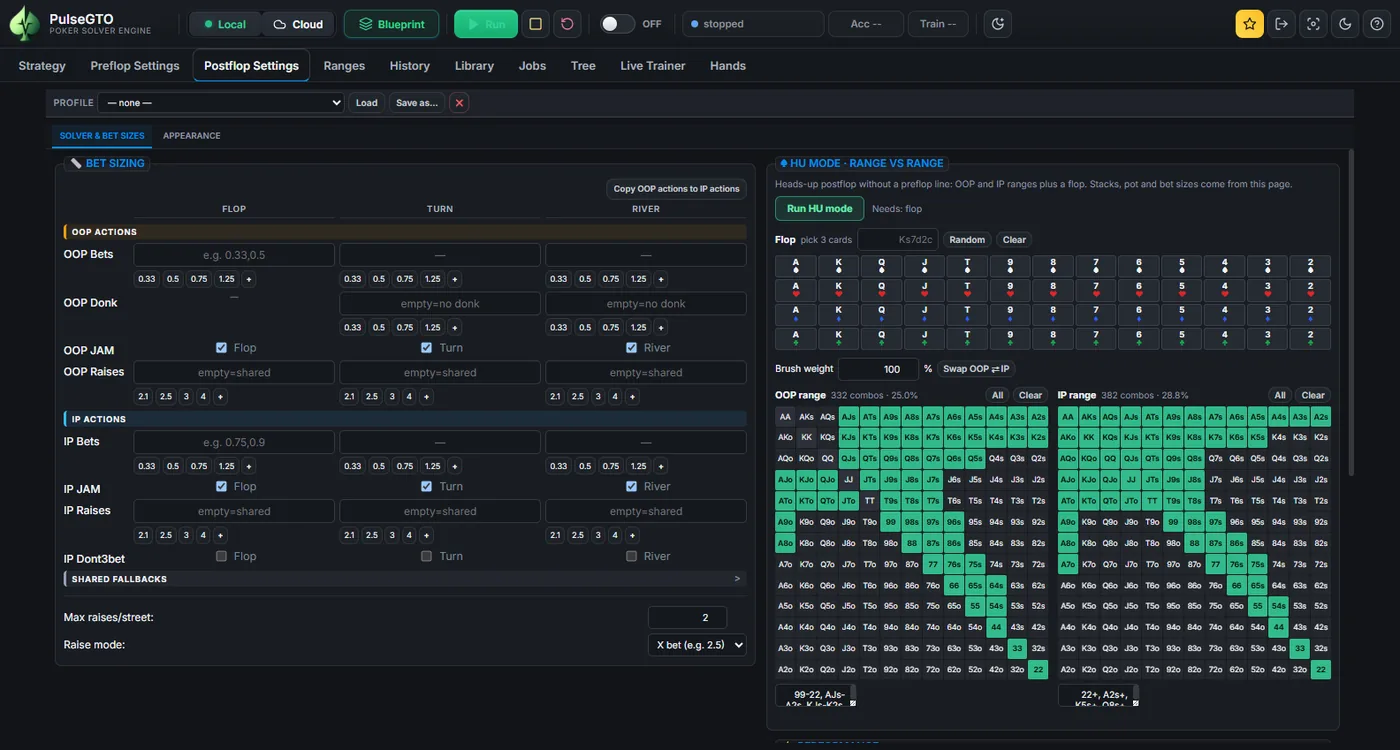
Recalculate Node uses the blueprint's own tree, so a re-solve matches the node it replaces. Change Node lets you edit the ranges and sizes first; the result then solves a different tree from the blueprint's.
Check the generated action, not just the number you entered
Two sizing modes can produce very different raises. Suppose the pot is 10 bb and the opponent bets 5 bb. A raise to 2.5 times that bet is 12.5 bb in total. A 50% pot raise first calls 5 bb, making the pot 20 bb, then adds 10 bb: a raise to 15 bb in total. This arithmetic example assumes no earlier street contribution at the node and no rounding or all-in conversion.
A size below the legal minimum may be increased by the engine; a size reaching the configured threshold may become a jam. Use Preview tree to inspect the actual action and stack behind. Record the resulting tree when comparing solvers, not just the text typed into the field.
For preflop, separate a normal 3-bet from a squeeze after a call and a BB 3-bet versus an SB open. A blank fallback can be intentional; verify it before treating a saved preset as your game.