 PulseGTO
Same line. Two turns. One big difference.
The big blind first to act on the turn, after check-calling a flop c-bet on T♦9♣4♥. Frequencies are weighted by each hand's reach.
On a brick turn the blueprint and the exact re-solve agree: the big blind checks its whole range. On the jack of diamonds they part ways. The exact re-solve leads with 27.7% of the range, built from the straights the jack completes and the strong draws that go with them, where the blueprint checks 98.2%.
The spot
Six-max pot-limit Omaha, 100 bb stacks, blinds 0.5/1, 5% rake capped at 1 bb, no flop no drop. Action folds to the button, who opens pot (3.5 bb); the small blind folds and the big blind calls. On T♦9♣4♥ the big blind checks, the button bets 66% of the pot (4.95 bb) and the big blind calls.
The turn pot is 17.4 bb and the big blind acts first. In the blueprint's tree it can check or bet 66% of the pot (11.48 bb). Re-solve keeps that same tree, as Recalculate does in Hold'em, so the two answers differ only in how they are computed.
Two ways to read the same node
- The blueprint is built for the whole game. After the flop it plays one strategy for each hand bucket, shared by all the flops and turns of a line. It answers instantly, for any line.
- Re-solve takes the ranges the blueprint reaches this node with and solves this turn on this board: every one of the big blind's and the button's hands separately, every river card.
Turn 2♠: the same answer
The deuce changes nothing for either range. The blueprint checks 99.6% and the exact re-solve 99.9%. Overpairs, two pair and the open-enders all check; the button keeps the initiative.
Turn J♦: the caller has the straights
The jack completes KQ, Q8 and 87, and the big blind's flop calls are full of them: hands with a straight are 29.8% of its range here, against 24.9% of the button's. On this exact board the re-solve uses that edge and leads.
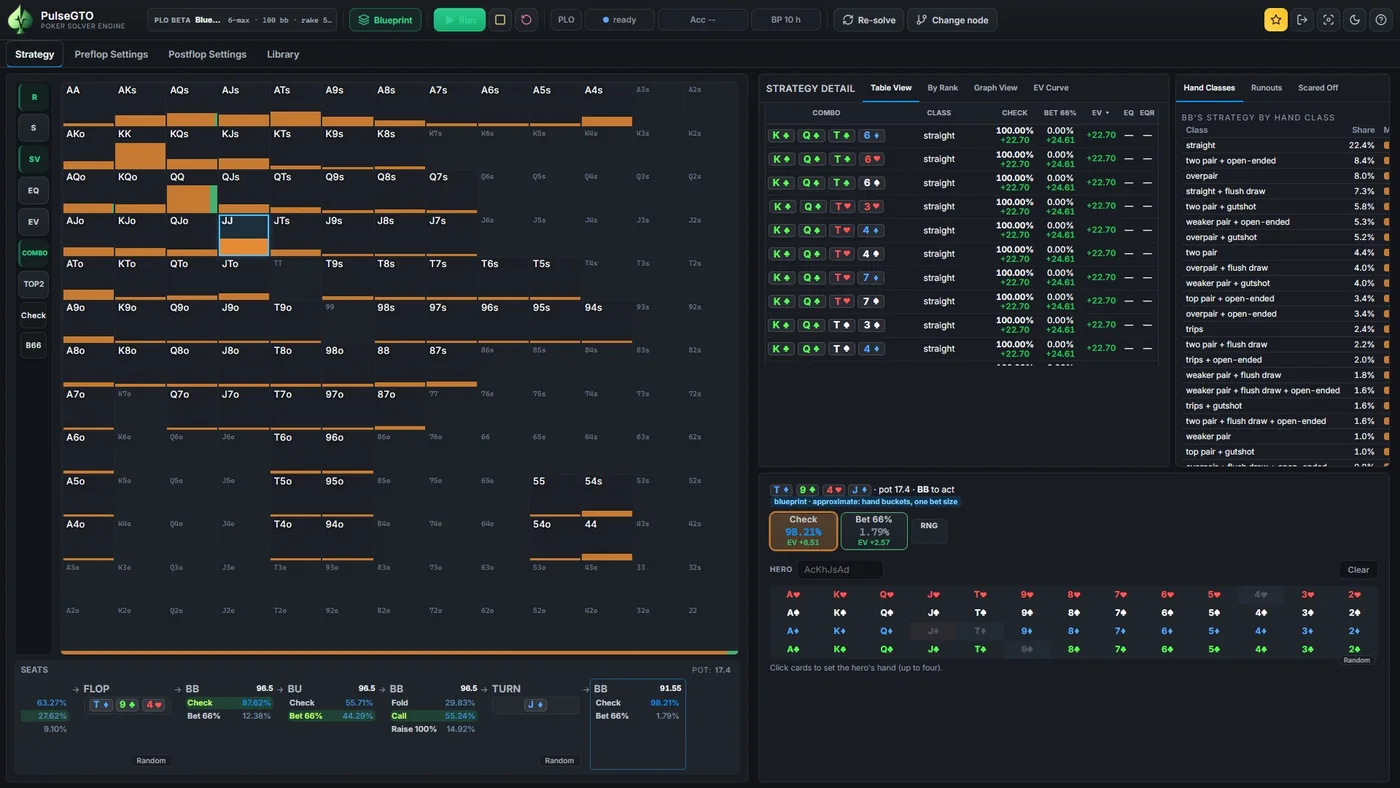
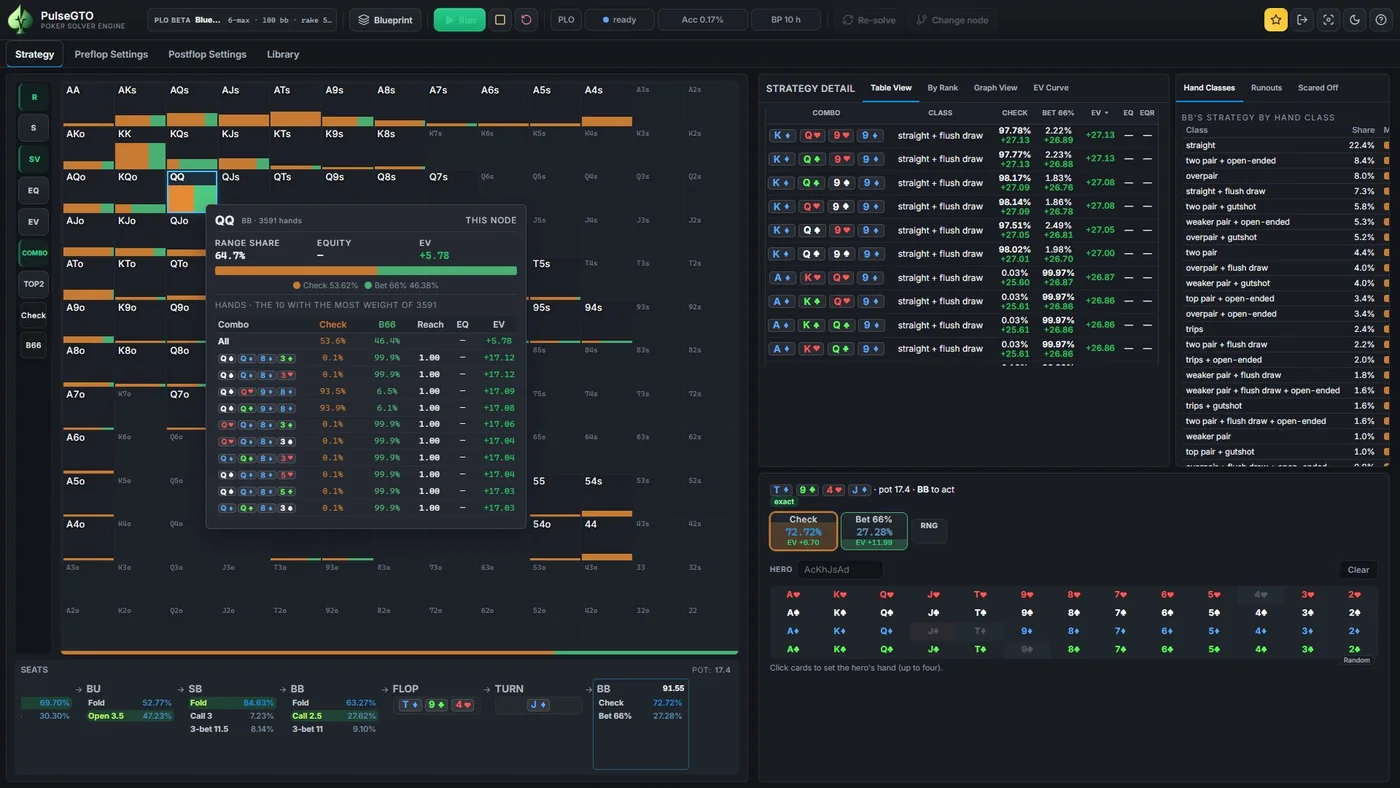
| BB's hand class on J♦ | Share of BB's range | Blueprint bets | Re-solve bets |
|---|---|---|---|
| straight | 22.4% | 0.0% | 38.7% |
| straight + flush draw | 7.3% | 0.0% | 51.8% |
| overpair + flush draw | 4.0% | 0.0% | 68.9% |
| overpair + open-ended | 3.4% | 0.0% | 74.5% |
| overpair | 8.0% | 16.5% | 10.4% |
| two pair | 4.4% | 0.0% | 6.0% |
- Straights lead 38.7% of the time, straights with a flush draw 51.8%.
- Overpairs with a flush draw (68.9%) and overpairs with an open-ender (74.5%) lead as well: strong hands that like building the pot before a river can change things.
- Hands such as A♦Q♣8♦6♥, the straight with the nut flush draw, lead every time.
The blueprint plays each straight bucket with one strategy across all the flops and turns of this line, and on this line that strategy is a check. A turn like this one is exactly the kind of node Re-solve exists for.
EVs for this board
Re-solve also gives exact EVs for this board. On the jack the big blind's range is worth 8.14 bb from this point and the button's 8.66 bb; the blueprint's estimates, averaged over its buckets and boards, are 8.40 and 10.10 bb. On the deuce the exact values are 5.06 and 11.52 bb.
What it costs
Each turn was re-solved for 80 iterations to an accuracy of 0.27% (J♦) and 0.25% (2♠) of the pot, in about 8 and 11 minutes on four threads of a laptop. With all cores it is faster.
When to press Re-solve
- The turn or river changes who has the nuts: a card that completes straights or flushes, or pairs the board.
- You are studying one specific board rather than a line in general.
- You want this board's EVs rather than the blueprint's estimates for the bucket.
For a quick overview of a line, the blueprint is instant. For the turn that decides the hand, Re-solve gives the exact answer in minutes.
What we have not shown
One line, two turns, one blueprint. We compared frequencies and EVs; we did not measure how much a player would lose by playing the blueprint's turn strategy against the exact one.
Reproduction notes
- PulseGTO PLO, the 6-max 100 bb blueprint (beta 2) with its postflop EVs; purify 2%.
- Line: BTN opens pot, SB folds, BB calls; T♦9♣4♥, BB checks, BTN bets 4.95 bb, BB calls; turn 2♠ or J♦.
- Re-solve from the BB's first turn decision, in the blueprint's tree (bet 66% of the pot, pot-size raise, one raise per street), with the blueprint's rake; 80 iterations, four threads.
- Both players' ranges are the blueprint's reach at the turn node; hands are compared one by one, and frequencies are weighted by the big blind's reach.
- Results are for this tree and these ranges, not universal PLO frequencies.
Try it on your own spots: the PLO guide and the PLO engine.