 PulseGTO
Bigger bet, more folds. The pairs stay.
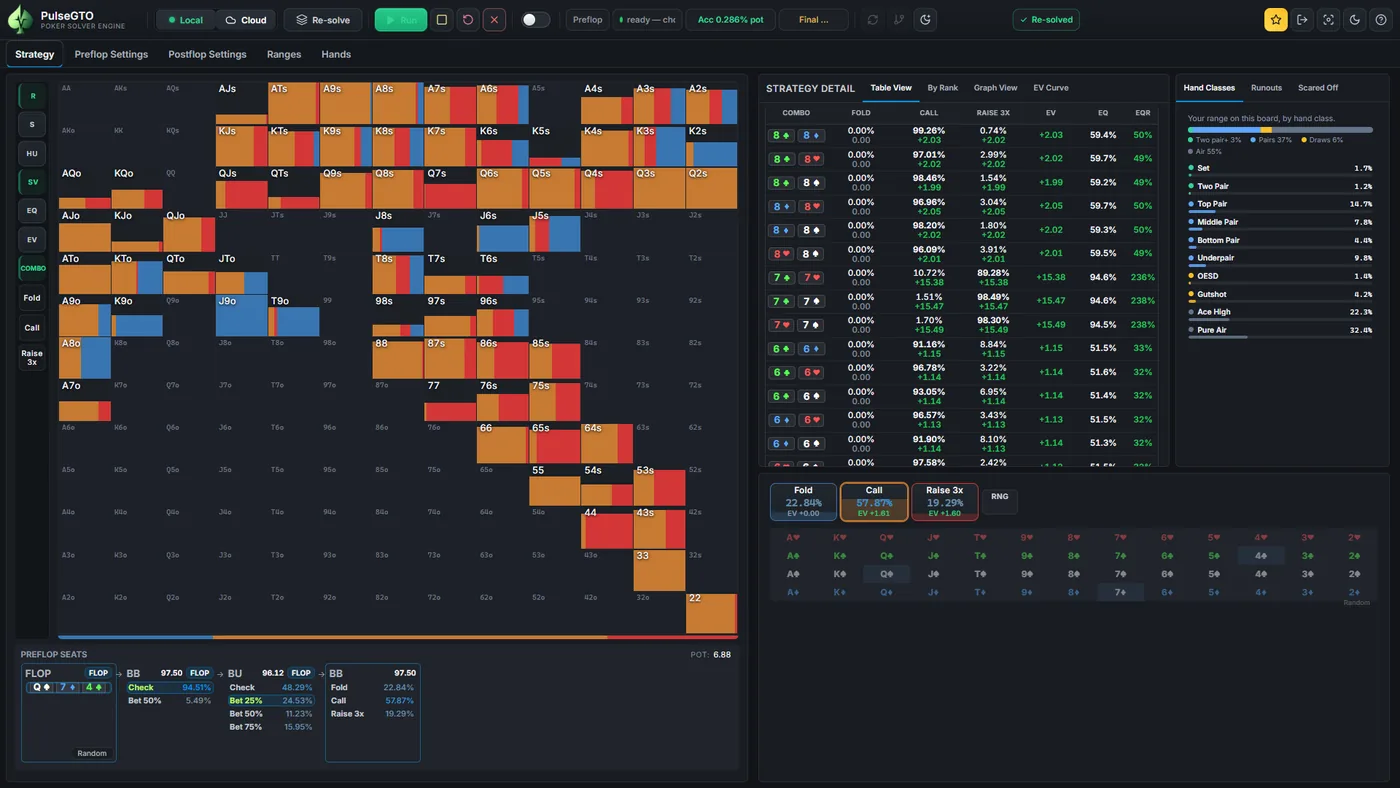
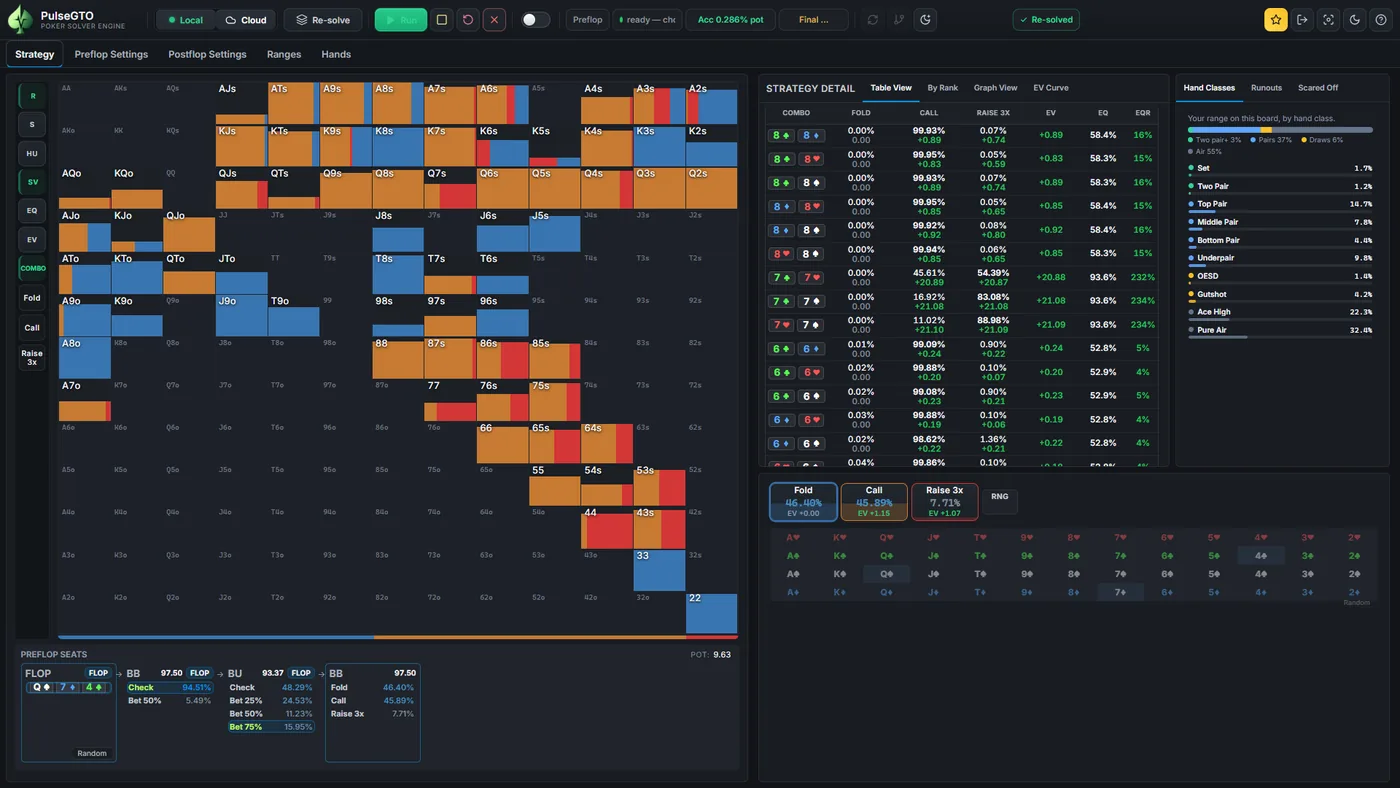
The big blind on Q♠ 7♦ 4♣ after checking, facing each of the button's three bet sizes. Full frequencies, hand classes and settings below. Three branches of one solve, from one custom configuration.
How should a defending range change when the c-bet gets bigger? The obvious part is that it folds more. The more useful part is which hands do the extra folding, and which hands do not move at all.
We re-solved one flop, Q♠7♦4♣, in a button-versus-big-blind single-raised pot and compared the big blind's answers to three bet sizes inside the same solution. Folding rises from 22.8% against a quarter-pot bet to 46.4% against a three-quarter-pot bet. The extra folds come from hands without a pair or a straight draw. Every hand that pairs the board keeps playing.
The spot
The game is six-handed with 100 bb stacks. The button opens to 2.5 bb, the small blind folds and the big blind calls. The flop pot is 5.5 bb, with 97.5 bb behind. Both preflop ranges come from one custom 6-max tree with 5% rake, a 4.5 bb cap and no flop no drop. They are the ranges that reach this line, not generic charts.
The flop was re-solved from the big blind's first decision. The big blind checks 94.5% of its range; its other option is a half-pot lead. After the check, the button plays:
| Button after the check | Amount | Share of range |
|---|---|---|
| Check | — | 48.3% |
| Bet 25% | 1.38 bb | 24.5% |
| Bet 50% | 2.75 bb | 11.2% |
| Bet 75% | 4.12 bb | 16.0% |
Each size is used often enough that the big blind's answers below are real branches of the strategy, not corner cases.
One flop, three answers
| Big blind facing | Fold | Call | Raise | Continues | MDF |
|---|---|---|---|---|---|
| 1.38 bb (25%) | 22.8% | 57.9% | 19.3% | 77.2% | 79.9% |
| 2.75 bb (50%) | 37.5% | 50.1% | 12.4% | 62.5% | 66.7% |
| 4.12 bb (75%) | 46.4% | 45.9% | 7.7% | 53.6% | 57.2% |
Range-weighted frequencies, rounded to one decimal. "Continues" is call plus raise. MDF (minimum defence frequency) is our pot-odds arithmetic, explained below, not a solver output.
Folding roughly doubles from the smallest bet to the largest, and raising falls from about one hand in five to about one in thirteen.
Pot odds: a benchmark, not the answer
Minimum defence frequency is pot ÷ (pot + bet): the share of its range the defender must continue with so that a bet with no equity cannot show an immediate profit. Against 4.12 bb into 5.5 bb, that is 5.5 ÷ 9.62 = 57.2%. The big blind continues with 53.6%.
At every size the solved defence sits three to four points below MDF. The formula leaves out the equity of the button's weaker hands when they are called, the rake, and everything that happens on later streets, where the big blind is out of position. This solve does not separate which of those accounts for the gap, so treat MDF as a reference line rather than a target.
Who folds, and who never does
| Big blind hand class | Share of range | Fold vs 25% | Fold vs 50% | Fold vs 75% |
|---|---|---|---|---|
| No pair, no draw, no ace | 21.2% | 73.3% | 88.0% | 95.3% |
| Ace-high, no draw | 16.5% | 28.2% | 60.2% | 80.3% |
| Backdoor flush draw only | 18.0% | 14.9% | 38.7% | 48.3% |
| Underpairs (22, 33) | 4.3% | 0.0% | 45.7% | 99.7% |
| Everything else* | 40.1% | 0.0% | 0.0% | 0.0% |
*Top pair, second or weaker pair, pocket pairs between the queen and the four (55, 66, 88), gutshots, open-ended straight draws, sets and two pair. Its share is the sum of those classes.
Ace-high is the swing group: it folds 28.2% against the quarter-pot bet and 80.3% against three quarters. Hands whose only draw is a backdoor flush fold more than three times as often against the big bet as against the small one. The underpairs switch completely, from calling 98.0% against the small bet to folding 99.7% against the big one.
About 40% of the range does not fold at any size. That includes every top pair, every second or weaker pair and every pocket pair between the queen and the four.
Same ranks, different answers
Single combos show how fine these lines are. EVs are in big blinds from this decision, with folding at 0.
| Combo | vs 1.38 bb | vs 2.75 bb | vs 4.12 bb |
|---|---|---|---|
| A♠9♠, ace-high with a backdoor nut flush draw | call 99.5% · EV +0.51 | call 99.3% · +0.45 | call 99.9% · +0.35 |
| A♥9♥, ace-high without a backdoor | call 86.1% · +0.03 | call 60.7% · +0.03 | call 40.6% · +0.05 |
| 8♥8♠, pocket pair below the queen | call 96.1% · +2.01 | call 99.0% · +1.50 | call 99.9% · +0.85 |
| 3♥3♠, underpair | call 100.0% · +0.36 | call 42.3% · +0.01 | fold 100.0% · call −0.13 |
A♠9♠ and A♥9♥ share their ranks. With the Q♠ on board, A♠9♠ also holds a backdoor draw to the nut flush, and calling stays clearly ahead of folding at every size. A♥9♥ has no backdoor: its calling EV stays within 0.05 bb of folding throughout, so it mixes, and the mix tilts towards folding as the bet grows. 3♥3♠ shows the threshold in one hand: calling is worth +0.36 bb against the small bet, about break-even against half pot and negative against three quarters.
Raises: most often against the small bet
| Hand class | Raise vs 25% | Raise vs 50% | Raise vs 75% |
|---|---|---|---|
| Set | 93.2% | 96.4% | 84.4% |
| Open-ended straight draw | 85.6% | 69.3% | 51.0% |
| Two pair | 82.7% | 59.1% | 43.2% |
| Gutshot | 60.8% | 59.9% | 42.4% |
| Second or weaker pair | 30.5% | 23.0% | 16.0% |
| Backdoor flush draw only | 30.2% | 14.3% | 8.1% |
| Top pair | 23.6% | 9.0% | 1.8% |
| Whole range | 19.3% | 12.4% | 7.7% |
Straight draws, sets and two pair never fold, and they raise at least 42% of the time at every size. Every class raises less against the 75% bet than against the quarter-pot bet. The largest drops are in the mixed classes: top pair goes from 23.6% to 1.8%, and backdoor-only hands from 30.2% to 8.1%. By our arithmetic from the class table, about 28% of the raises against the small bet come from backdoor-only hands and about 37% from top pair or second pair.
What this changes in a study session
When you compare defences against different sizes, three questions are more useful than the overall fold percentage:
- Which classes switch from calling to folding as the bet grows? Here: ace-high, backdoor-only hands and the smallest pocket pairs.
- Which hands never fold? Here: every hand that pairs the board, the pocket pairs between the queen and the four, and the straight draws.
- How does the raising range change? Here it shrinks from almost a fifth of the range to under a tenth, and the mixed hands leave it first.
What we have not shown
These are the big blind's equilibrium answers to the button's betting ranges in this solve. They do not show how the big blind should adjust against a player who bets differently, for example one who uses the large size only with strong hands. That needs a separate solve with the button's strategy locked.
The results also do not establish a rule for other flops, stack depths, rake structures or player pools, and the solve does not isolate why the defence sits below MDF.
Reproduction notes
- One heads-up postflop RangeCFR re-solve in PulseGTO, from the big blind's first flop decision, with ranges from a custom 6-max 100 bb preflop tree.
- Ranges below the GUI's default relative cutoff of 1% of the largest combo reach were omitted: 369 big-blind combos and 544 button combos remain.
- Big blind: check or lead 50%. Button after a check: 25%, 50% or 75% of the pot, rounded to 0.01 bb: 1.38 bb, 2.75 bb and 4.12 bb (25.1%, 50.0% and 74.9% of 5.5 bb).
- Turn and river bets: 75%; leads into the previous street's aggressor: 50%. Raises: 3× on flop and turn, 2.5× on river, at most two per street; all-ins allowed. These are simplified downstream trees.
- Reported final accuracy: 0.286% of the starting pot after 334 iterations. This is the engine's reported average best-response gap across both players, not a guarantee of each individual frequency's precision.
- Hand classes take the made hand first (set, two pair, top pair, other pairs, pocket pairs by their position against the board), then the strongest draw; hands with neither are split into ace-high and the rest. Single combos are specific examples, not class averages.
- MDF, "Continues", the 40.1% share and the raise breakdown are arithmetic on the exported frequencies, not solver outputs.
PulseGTO was used for the calculations and recorded outputs. The aim is to show how a defending range changes shape with the bet size, not to supply a chart to memorise. Explore the postflop solver.