 PulseGTO
Same 3-bet pot. Opposite flop plans.
The small blind's first flop decision after 3-betting the button and getting called. Bets of 5, 10 and 16 bb (about a quarter, half and three quarters of the 21 bb pot), labelled 25%, 50% and 75% in the solver. Three examples from one custom configuration.
When the small blind 3-bets the button and gets called, it starts the flop out of position as the preflop aggressor. Depending on the flop, the solver has it bet almost every hand or check almost every hand, including its strongest ones.
We re-solved three flops on the same line. The small blind checks 4.9% on A♠7♦2♣, 0.0% on K♠8♦3♣ and 90.4% on 9♠8♦7♦. The ranges differ on each flop in ways that fit this contrast, but that link is a hypothesis: the solves show the strategies, not their causes.
The spot
The game is six-handed with 100 bb stacks. The button opens to 2.5 bb, the small blind 3-bets to 10 bb, the big blind folds and the button calls. The flop pot is 21 bb, including the big blind's 1 bb, with 90 bb behind: a stack-to-pot ratio of about 4.3. Both preflop ranges come from one custom 6-max tree with 5% rake, a 4.5 bb cap and no flop no drop.
The small blind acts first and can check or bet. After a check, the button can check or bet.
A note on bet sizes. These solves rounded every bet to whole big blinds. The small blind's three flop bets, labelled 25%, 50% and 75% in the solver, were 5, 10 and 16 bb: about a quarter, a half and three quarters of the 21 bb pot (23.8%, 47.6% and 76.2%). The button's bet after a check was 10 bb. Turn and river bets were rounded the same way. The strategies are exact solutions for these amounts, and all three flops share them, so the comparison between flops holds.
Three flops, three plans
| Flop | Check | Bet 5 bb | Bet 10 bb | Bet 16 bb |
|---|---|---|---|---|
| A♠7♦2♣ | 4.9% | 45.9% | 32.6% | 16.6% |
| 9♠8♦7♦ | 90.4% | 6.2% | 1.1% | 2.3% |
| K♠8♦3♣ | 0.0% | 9.2% | 47.8% | 42.9% |
Range-weighted frequencies of the small blind's first flop decision, rounded to one decimal. All-in was available and not used.
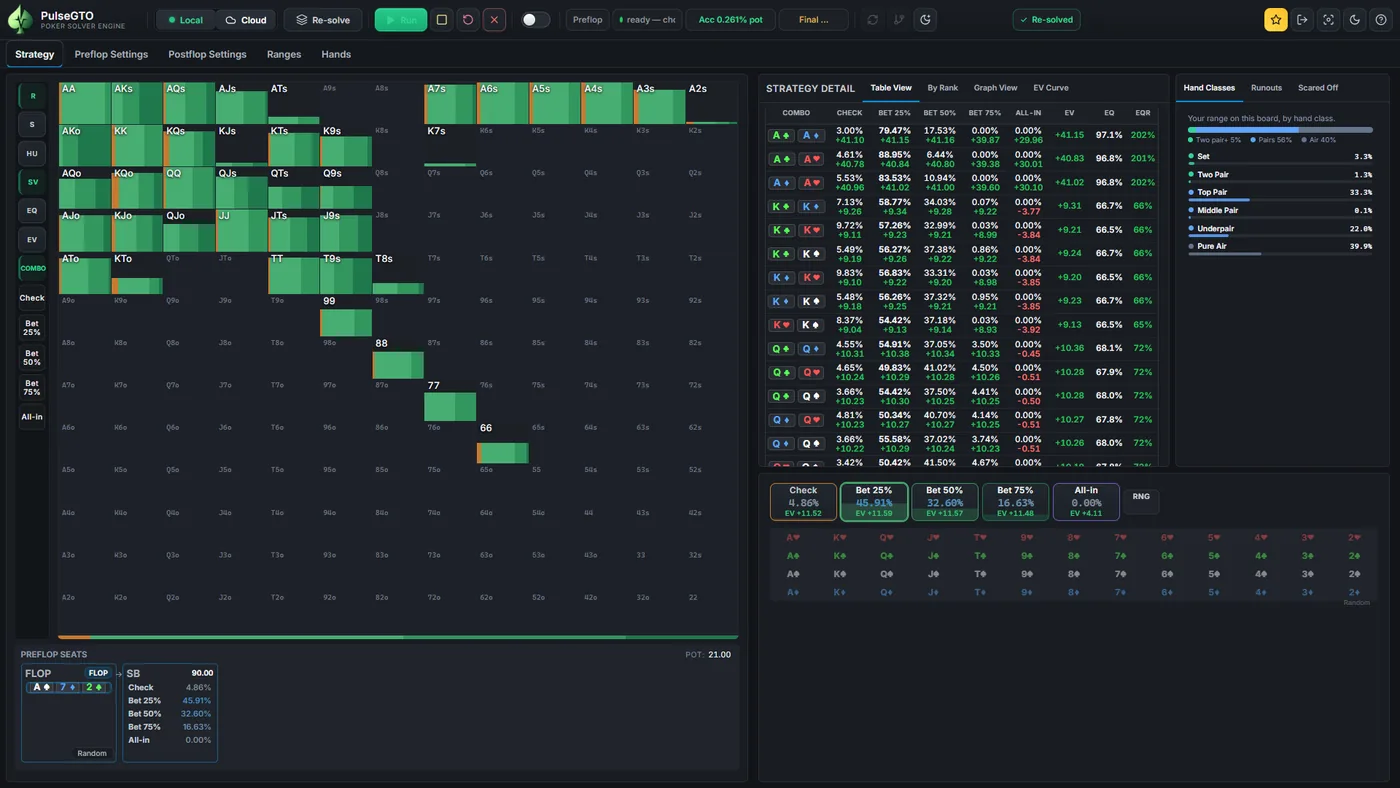
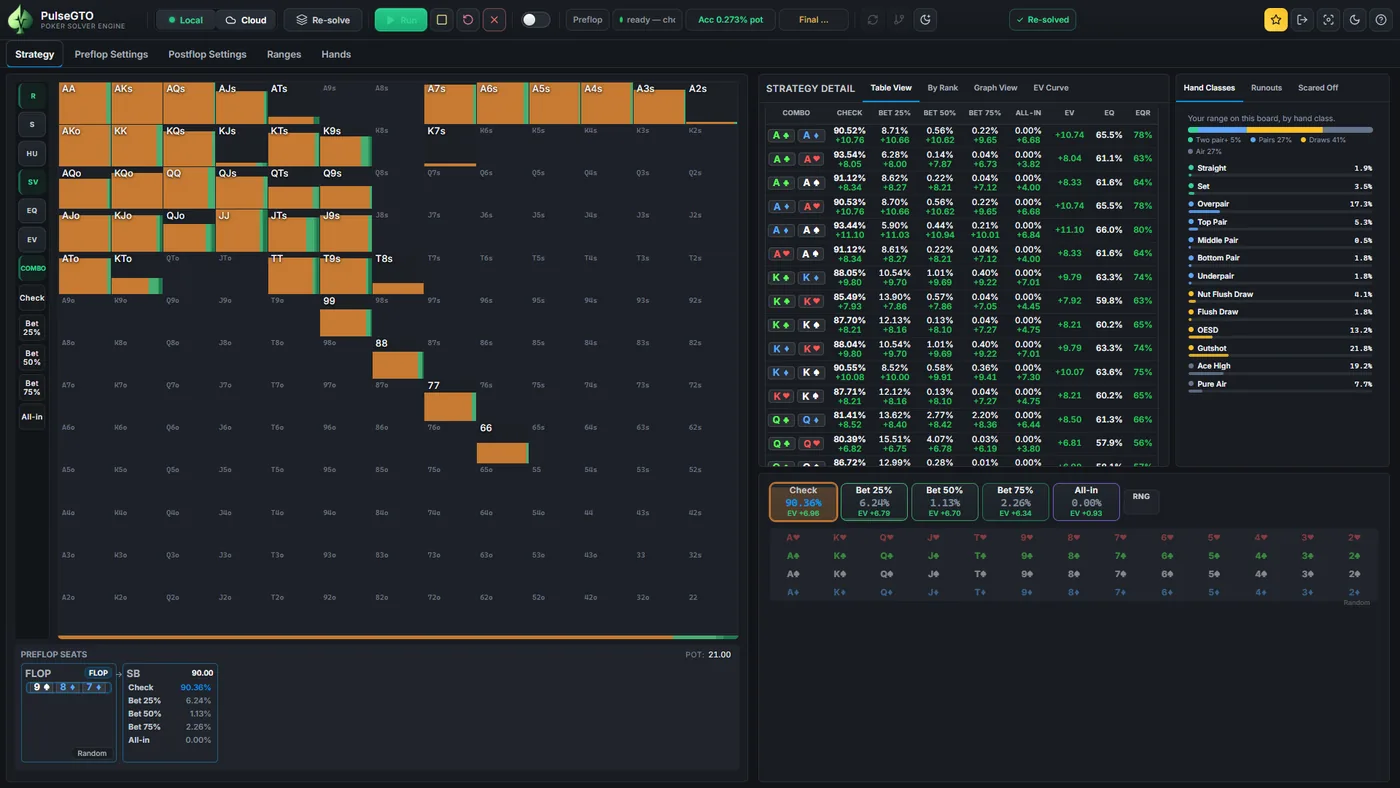
A♠7♦2♣: nearly every hand bets
No hand class checks more than 8.8% of the time, and that maximum belongs to the hands with no pair and no draw. Top pair checks 3.3%, the pocket pairs below the ace 4.8%. The smallest size carries most of the betting: 45.9% of the range bets 5 bb. A♣A♦, a top set here, bets 97.0%, mostly 5 bb. K♦J♣, with no pair and no draw, still bets 94.5%.
The button's answers:
| Button facing | Fold | Call | Raise |
|---|---|---|---|
| 5 bb | 20.2% | 61.1% | 18.6% |
| 10 bb | 34.9% | 63.1% | 2.1% |
| 16 bb | 46.9% | 53.1% | 0.0% |
Against 5 bb the button raises its top pairs 31.4% of the time and folds most hands with no pair and no draw (87.8%). Against 16 bb, top pair always calls, while the pocket pairs below the ace fold 33.4%.
9♠8♦7♦: the strong hands check too
Here the small blind checks 90.4%, and the check is not a range of weak hands. Sets check 88.7%, straights 71.8% and overpairs 86.8%. Every hand class checks at least 71.8% of the time.
Two hands make the contrast concrete:
| Small blind hand | A♠7♦2♣ | 9♠8♦7♦ |
|---|---|---|
| A♣A♦ | top set: bets 97.0% | overpair: checks 90.5% |
| 7♣7♥ | set: bets 99.9% | set: checks 91.7% |
After the check, the button takes over. It bets 10 bb with 56.9% of its range, including 96.5% of its straights and 81.9% of its sets, while its top pairs without a strong draw mostly check back (86.3%).
When the small blind does bet here (9.6% in total), the button raises the 5 bb bet 30.0% of the time. That branch is rarely reached, so it carries less weight than the main lines.
What the ranges look like
| Share of range | A72 SB | A72 BTN | 987 SB | 987 BTN |
|---|---|---|---|---|
| Equity against the other range | 58.3% | 42.8% | 47.1% | 52.3% |
| Top pair | 33.3% | 24.8% | 5.3% | 8.8% |
| Sets, straights and two pair | 4.6% | 2.2% | 5.4% | 15.6% |
| Overpairs | — | — | 17.3% | 3.4% |
Shares of each player's range at the flop; no overpair is possible under an ace. Equity is the reach-weighted average of each combo's equity against the other range, so a pair of numbers need not add up to exactly 100%.
One reading (a hypothesis, not tested here). On A♠7♦2♣ the small blind's range is well ahead and holds more top pairs and more sets and two pair, so betting with nearly everything fits. On 9♠8♦7♦ the edge flips: the button's calling range holds about three times the small blind's share of sets, straights and two pair. The small blind's extra overpairs rank below those hands, and it checks them along with almost everything else.
K♠8♦3♣ fits the same picture from the other side. The small blind has 57.3% equity against 42.8%, holds 24.2% top pair against the button's 13.0%, and bets its entire range, mostly with the 10 and 16 bb sizes.
Is it the 3-bet pot?
On the same flops in a single-raised pot, where the button opens and the big blind calls, the button as the preflop raiser checks back 44.5% on A♠7♦2♣ and 31.4% on K♠8♦3♣ after the big blind checks. On 9♠8♦7♦, in a related tree with an extra 125% bet and bets rounded to whole big blinds, it checks 48.7%.
So the raiser's check frequency stays between 31.4% and 48.7% in the single-raised pot, and runs from 0.0% to 90.4% in the 3-bet pot. That difference is real in these solves, but it is not an effect of pot size alone. The ranges differ (a 3-betting range against a calling range, instead of an opening range against a big-blind defence), the stack-to-pot ratio differs (about 4.3 against 17.7), and so does position: the single-raised-pot raiser acts last, the 3-bettor acts first.
What we have not shown
- Why the strategies differ. Range composition fits the pattern; it is not an isolated test.
- What a simpler strategy would cost, such as one bet size on A72 or checking every hand on 987. That needs a restricted solve.
- Exact quarter-, half- and three-quarter-pot sizes. In a separate single-raised-pot check, exact amounts moved the check frequency by 2.6 to 4.5 points per flop and the split between sizes by more. This spot has not been re-solved that way.
- Other flops, stack depths, rake structures or player pools. At this stack-to-pot ratio all-ins become frequent on later streets, and those frequencies depend on the single turn and river bet size (nominally 75%, rounded to whole big blinds).
Reproduction notes
- Three separate heads-up postflop RangeCFR re-solves in PulseGTO, one per flop, from the small blind's first flop decision, with ranges from a custom 6-max 100 bb preflop tree. Same tree and stopping target on every flop.
- Ranges below the GUI's default relative cutoff of 1% of the largest combo reach were omitted.
- Small blind: check, or bet 5, 10 or 16 bb (nominal 25%, 50% and 75%). Button after a check: check or bet 10 bb (nominal 50%). Turn and river: one bet size of 75% and a 50% lead into the previous street's aggressor, rounded to whole big blinds. Raises: 3× on flop and turn, 2.5× on river, at most two per street; all-ins allowed.
- Reported final accuracy: A72 0.261%, 987 0.273%, K83 0.260% of the starting pot. This is the engine's reported average best-response gap across both players, not a guarantee of each individual frequency's precision.
- Range equity is the reach-weighted average of each combo's equity against the opponent's range at the flop. Class shares and their sums are arithmetic on the exported tables.
- PulseGTO's preflop blueprint stores its own, coarser flop strategy for this line, with 33% and 50% bets. It points the same way: it checks 34.5% on A72 and 63.2% on 987.
- Single-raised-pot comparison: separate button-versus-big-blind re-solves of the same flops (A72 and K83 with bets rounded to 0.01 bb; 987 with an extra 125% option and whole-big-blind rounding).
PulseGTO was used for the calculations and recorded outputs. The aim is to read a flop strategy by hand class, not only by its overall betting frequency. Explore the postflop solver.